
The Integrated Phases DtGC Operational Framework
Green Target & Governance
In complex industrial engineering decisions, trade-offs cannot rely on a single metric. DtGC structures product redesign as a constrained multidimensional optimization problem evaluated through the synthetic DtGCScore:
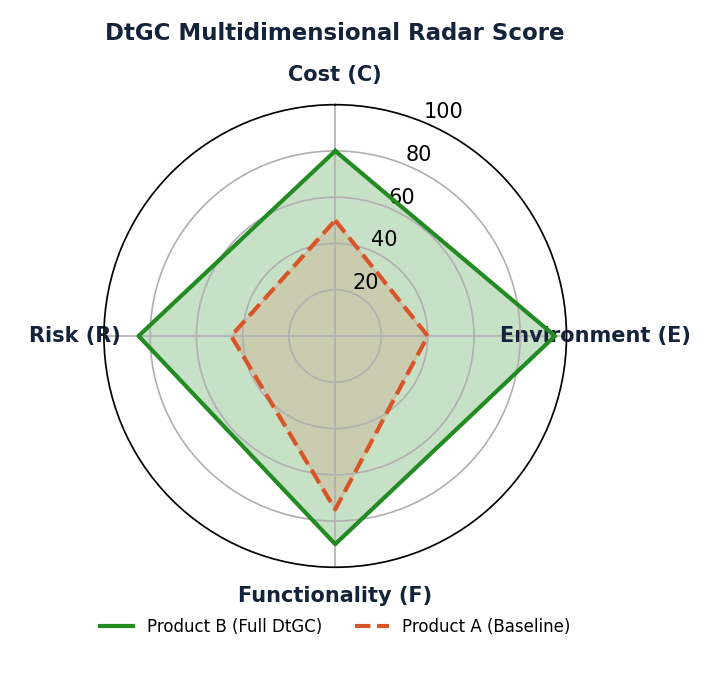
- Phase 1 – Target & Governance Definition:
C-Level Board sets target operating margins, market price constraints, and strategic algorithm weights (Wc , We , Wf , Wr ) for the DtGC Score.
Value Analysis, Split LCA & Monetization
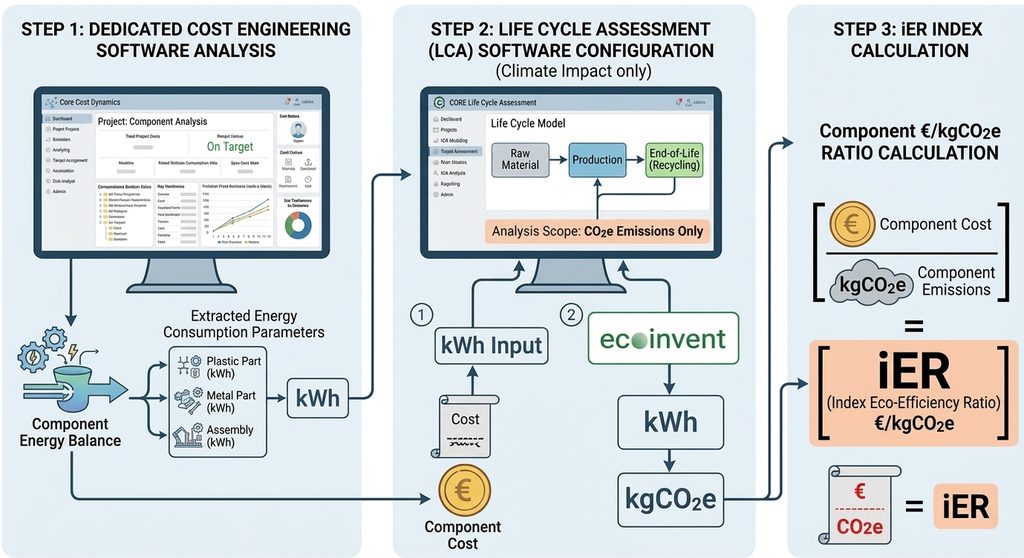
- Phase 2 – Value Engineering & Hard Constraints Validation:
Engineering teams decompose functional requirements and enforce non-negotiable safety and quality gates (F ≥ F_min). - Phase 3 – Impact vs. Exposure Separation:
Cost Engineering maps direct industrial costs (Ce),
Green Engineering quantifies carbon footprint (Ge) and monetized liabilities (GreenOpEx).
Eco-design 7R & Strategic Green Sourcing
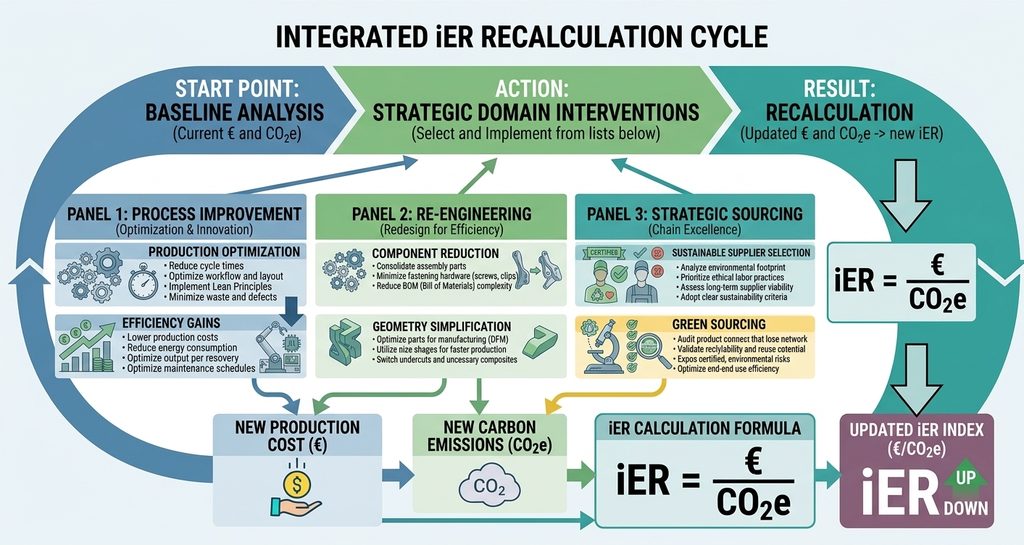
- Phase 4 – Eco-Design Alternatives Generation:
Cross-functional teams apply the 7R framework (Redesign, Reduce, Recycle, Re-source, etc.) to generate competing BOM options. - Phase 5 – Integrated Dual-Gate Decision Making:
Applies a two-stage evaluation gate before technical freeze:
Dual-Gate Model:- R&D & Engineering:
Technical Eco-Efficiency Check (ΔiER > 0). Filters options that optimize the cost per kg CO2e. - C-Level Board & ESG Controller:
Strategic Selection (Max DtGC Score). Selects the global optimum that maximizes financial return and minimizes supply chain risk.
- R&D & Engineering:
PDA Continuous Control : The Evolving Role of the ESG Controller
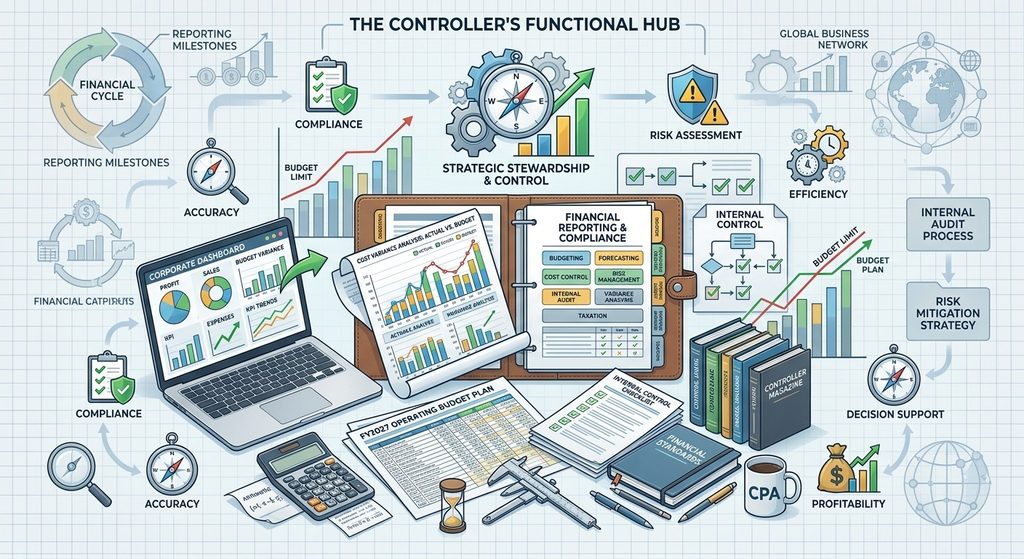
- Phase 6 – Monitoring & Continuous Improvement (PDCA):
Post-launch monitoring by the ESG Controller to reconcile P&L performance, track regulatory evolution, and feed data into future product generations.
ESG Controller in Design to Green Cost (DtGC)
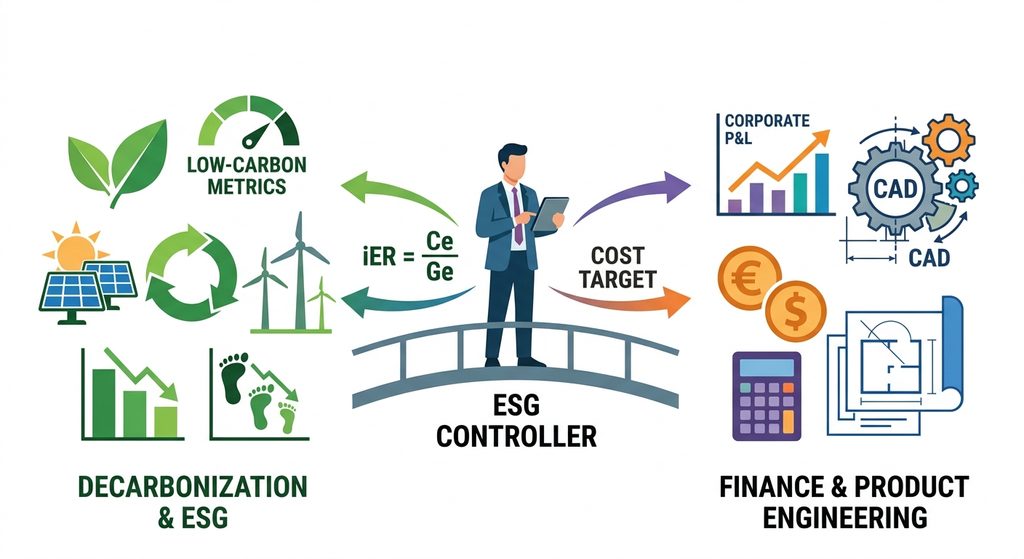
In the Design to Green Cost (DtGC) methodology, the ESG Controller evolves from a passive, ex-post compliance auditor or sustainability reporter into a proactive,
ex-ante financial and operational orchestrator embedded directly within early-stage product engineering and R&D.
Positioned precisely at the intersection of Finance, Product Engineering, Procurement, and Decarbonization, the ESG Controller serves as the vital “cross-functional translator” who bridges technical design choices at the Bill of Materials (BOM) level directly with C-Level Profit & Loss (P&L) performance.
Key Activities & Operational Responsibilities
Ex-Ante Economic Environmental Exposure Modeling
- Translating Emissions into Financial Exposure: Converts physical Life Cycle Assessment (LCA) data (kg CO2e) into concrete Economic Environmental Exposure.
- BOM-Level Monetization: Quantifies regulatory liabilities—such as Carbon Border Adjustment Mechanism (CBAM) tariffs, EU Emissions Trading System (EU ETS) carbon costs, Extended Producer Responsibility (EPR) levies, and direct manufacturing energy surcharges—directly into unit production costs before the technical freeze.
Managing the Dual-Gate Decision Engine
- Engineering Level : Guides R&D and Cost Engineering teams using the Eco-Efficiency Ratio (iER = Ce / Ge), ensuring that every Value Optimization redesign satisfies ΔiER > 0 to drive down carbon costs per unit.
- Executive C-Level Level : Models and evaluates the multidimensional DtGCscore to resolve complex trade-offs between industrial manufacturing costs, environmental exposure, functional performance, and supply chain risks.
Strategic Target Setting & Governance
- Collaborates with executive leadership (CEO/CFO) to define project target costs and configure strategic weighting parameters (Wc, We, Wf, Wr) aligned with corporate risk tolerance, regulatory exposure, and EBITDA targets.
P&L Integration & Accounting Mapping
- Maps environmental liabilities directly onto statutory P&L account items (such as Raw Materials under Item B.6, Services under Item B.7, and Other Operating Expenses under Item B.14).
- Operationalizes the revised target cost equation (Price – Margin – Environmental Exposure = Cost Target) to protect operating margins against regulatory erosion.
Ex-Post Reconciliation & Continuous Control
- Conducts post-production variance analysis comparing actual procurement, energy, and material data against project DtGC baselines.
- Feeds a Plan-Do-Check-Act (PDCA) continuous learning cycle to update costing databases and carbon intensity factors for subsequent product generations.
Core Competencies & Essential Skill Set
- Financial Controlling & Cost Accounting: Deep expertise in management control systems, budgeting, target costing (Design to Cost), variance analysis, and statutory P&L reclassification.
- Carbon Accounting & Regulatory Mechanics: Advanced knowledge of Scope 1, 2, and 3 emissions modeling, CBAM import customs mechanics, EU ETS allowance pricing, EPR directives, and ESG frameworks (GRI/CSRD/ESRS).
- Product Engineering & CAD/BOM Literacy: Ability to navigate mechanical CAD platforms, interpret manufacturing process parameters (cycle times, material scrap), and understand Bill of Materials (BOM) structures alongside R&D engineers.
- Data Analytics & BI Architecture: Proficiency in designing relational databases, Power BI dashboards, and data architecture to transform raw engineering and emissions datasets into actionable executive insights.
- Cross-Functional Communication (“The Translator”):
- With C-Level Leadership: Translates engineering decisions into operating margin protection and P&L impacts.
- With R&D & Engineering: Translates financial targets and carbon liabilities into concrete design choices.
- With Procurement: Evaluates Tier-1 supplier selections against embedded CBAM, EU ETS, and circular economy metrics.
- With Sustainability Teams: Filters physical LCA outputs to isolate business-relevant economic drivers.